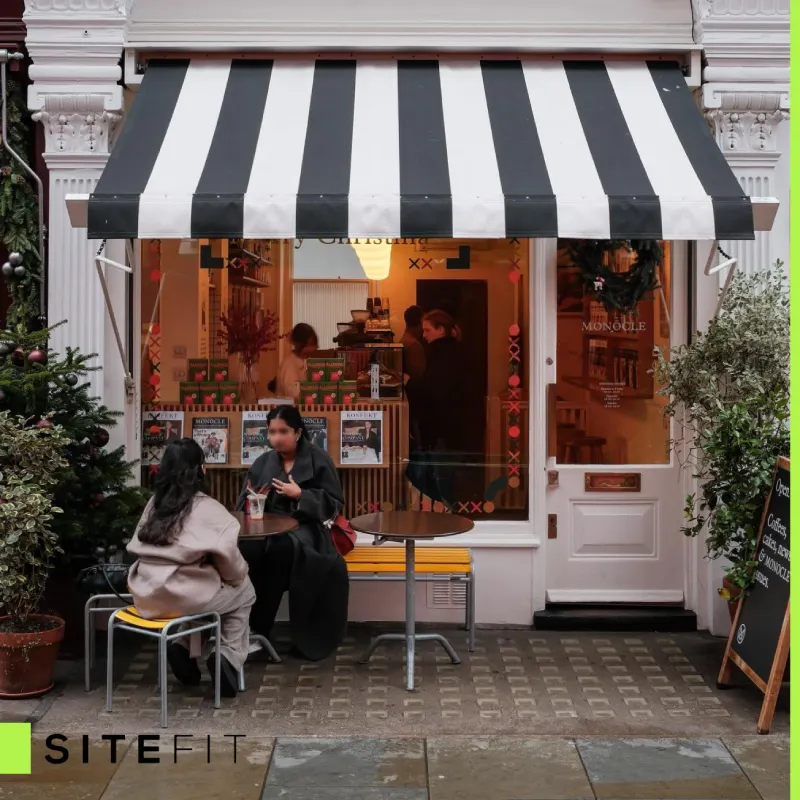

“High footfall” is one of the first phrases people notice in a commercial property listing. It sounds like a shortcut to a busy shop and a healthy till. But a lively street does not show how many people will enter a particular unit, whether they need what you sell, or whether they will come at the times you trade. Footfall data can be useful when its source, area, date and method are clear. A quick count during a viewing is something else entirely. Before choosing a London property because it looks busy, separate measured information from what you observed and ask whether the activity fits your business. That gives you a better starting point than treating movement on a pavement as a promise.
What people mean by footfall
People use “footfall” to mean different things: a formal pedestrian-count dataset, a sensor estimate, a town-centre monitoring figure, or simply the number of people they remember seeing outside. Those measures are not interchangeable. Before using a number, find out who collected it, when, where, by what method and what the count includes. Was it a single hour or a longer period? A street segment or a shopping centre? A weekday or a weekend? Without that context, a large number may answer a different question from the one your business needs.
If a property listing says the location has high footfall, ask for the source and supporting period. If the answer is not available, treat the statement as an unverified claim, not a measured fact. During your own visit, write down what you saw at the time. That observation can still help you understand the street, but label it accurately. One busy moment cannot establish a daily or seasonal pattern, and a quiet visit does not prove that the area is always quiet.
A person passing is not necessarily a potential customer
The people moving through an area may be travelling somewhere else, waiting for transport, heading to work or visiting a nearby destination. Their route, reason for being there and available time matter. Someone rushing for a train may be relevant to a takeaway coffee offer and less relevant to a long sit-down visit. A pedestrian count does not tell you what people want, whether they can see the unit, or whether the price and offer suit them.
Think about the customer occasion your business depends on. Which people might notice the premises, enter and choose your service? What would make them stop? Does your offer match the times they are nearby? The answer may involve passing trade, local residents, workers, destination visits or repeat customers. Do not assume that the biggest crowd is automatically the best fit. A smaller but better-matched customer context may be more relevant to your concept, though that too needs evidence and should not be turned into a sales prediction.
Match the activity to your business and trading hours
Different businesses need different patterns. A coffee shop might care about a morning route, local lunchtime visits or weekend neighbourhood activity. A restaurant may depend on lunch, evening bookings, walk-ins or takeaway. A hair or beauty salon may rely more on planned appointments and repeat customers than spontaneous pavement stops. The address should be assessed against the business you intend to run, not a generic idea that “busy is good”.
Visit during the periods that matter to your plan, on more than one occasion where possible. Record the day, time, weather, nearby events and what you noticed. Look at the route to the entrance, not just the main road. Are people on the other side of a barrier? Is the unit set back or hard to see? Is the street busy only when neighbouring offices or venues are open? These details can help you form better questions, but they do not replace reliable measurement when a measured count is essential to your decision.
- Choose observation times that match your planned opening hours.
- Note routes, crossings, visibility and the actual entrance.
- Keep each visit's conditions beside your observation.
Separate footfall from nearby customer context
Population, household and workplace data can help describe who lives or works in a wider area. Transport data can describe services, routes or stops. Business records can help identify nearby places. These sources may add context to a location decision, but none should silently become a count of measured pedestrians outside a particular shopfront. Each has its own geography, date, definition and limits.
When you read a chart or report, check the original source and ask what it measures. A statistic for a neighbourhood does not describe every street. A stop nearby does not prove that customers use the route to your door. A business directory may include stale or broad-category records. Write down the source and the conclusion it can support, then note what it cannot tell you. This is how you avoid a common leap: treating a related indicator as if it were direct evidence of visits, demand or spending at one property.
Look at competitors and the street together
A busy location often contains several reasons for people to be there and several businesses competing for attention. Visit relevant alternatives and see what they offer, when they appear active and how customers reach them. A count of cafés or restaurants is not a measure of market demand, and activity outside one venue does not reveal its revenue. Still, direct observations can help you understand the customer choices and the shape of the area.
Ask what makes your proposed business distinct for the customer and occasion you have in mind. If the area has many similar options, research how they differ before deciding that the market is full. If there are few visible alternatives, find out whether customers have another way to meet the same need or whether the area works differently at other times. A gap is not proof of unmet demand, just as a cluster is not proof that a new business cannot fit. Keep both explanations open until the evidence supports a clearer view.
Check the route, visibility and premises
People can be close to a unit and still have little reason or ability to enter. Examine the approach from the routes your likely customer uses. Is the frontage visible? Is the entrance obvious? Can customers cross the road conveniently? Are there barriers, steps or other practical issues to assess? What happens when several people arrive at once? A site visit helps you ask these questions, while accessibility and building requirements should be checked by someone qualified to assess them.
Then consider whether the premises itself fits the offer. Layout, condition, utilities, storage, delivery access, equipment and permissions may matter as much as street activity. Ask the landlord or agent for documents and have the appropriate professionals review them. Do not assume that a busy site is operationally suitable or that a previous tenant's use proves your proposed business can operate in the same way. The property and the surrounding area are related parts of the decision, but they answer different questions.
Use evidence proportionately
If a reliable pedestrian-count dataset exists for the relevant street and period, read its methodology and limitations before using it. If it does not, say so. You can still combine visits, local context, competitor research and premises checks to form a more complete view, provided you keep each source type clear. Do not invent a number, extrapolate one short count into a year, or label an estimate as observed fact. If a conclusion depends on a measurement you do not have, keep that conclusion uncertain.
A useful evidence note might say: “On two weekday lunchtime visits, I observed steady movement outside the unit. These visits do not establish a typical daily count. I still need a reliable measure if the business plan depends on a specific volume.” That is more informative than “high footfall” because it tells you what happened and what remains unknown. The right standard depends on the importance of the question and the cost of being wrong.
Decide what to check next
Before choosing the property, write down why the observed or measured activity matters to your business, what evidence supports the point, and what could weaken it. Ask whether the source matches your opening hours, customer route and premises. If the issue is a time-of-day pattern, make another visit. If a listing makes a measured claim, request its source. If the property has a practical constraint, get the plans or an expert view. This turns a vague impression into a sequence of specific checks.
SiteFit can put a London address into context for a coffee shop, restaurant or salon. It does not treat transport or population data as measured shopfront footfall and cannot guarantee customer numbers or sales. Use its assessment alongside observations, property documents and professional advice. High footfall may be relevant, but the useful decision is whether the location, customer context and premises fit your business, with uncertainty stated honestly.